The maker behind the range, and why China-made matters
The miso described in this guide is made by Marusan Ai Co., Ltd. (マルサンアイ株式会社), a miso manufacturer based in Niki-machi, Okazaki, Aichi, Japan. Production for the Chinese and export market runs in China under the Japanese parent's supervision - the 20 kg foodservice cartons carry that supervision mark - and the China side is handled by its Shanghai trading company, 九三爱食品商贸(上海)有限公司. Retail packs carry the 蔵の匠 brand, written 藏之名匠 on Chinese labels.
That structure is the reason China-made no longer reads as a compromise. The recipe, the koji and the supervision are Japanese; the plant, the labour and the loading port are Chinese. For an importer the difference is commercial rather than sensory: goods move from a Chinese port on a Chinese export document set, the cost base is in RMB, and a mixed order across several paste types is a realistic first shipment rather than a container-scale commitment.
It also means the specification travels with the brand. A buyer dealing in 蔵の匠 product is not comparing an anonymous commodity paste; the koji ratio, salt level and aging period behind each style name are fixed by the maker, and the range below is the one those names refer to. LongKi Foods handles the export side of that conversation, and the rest of this guide deals with the formula and the format, which is where most first quotes go wrong.
Beyond white, red and awase: what the range actually contains
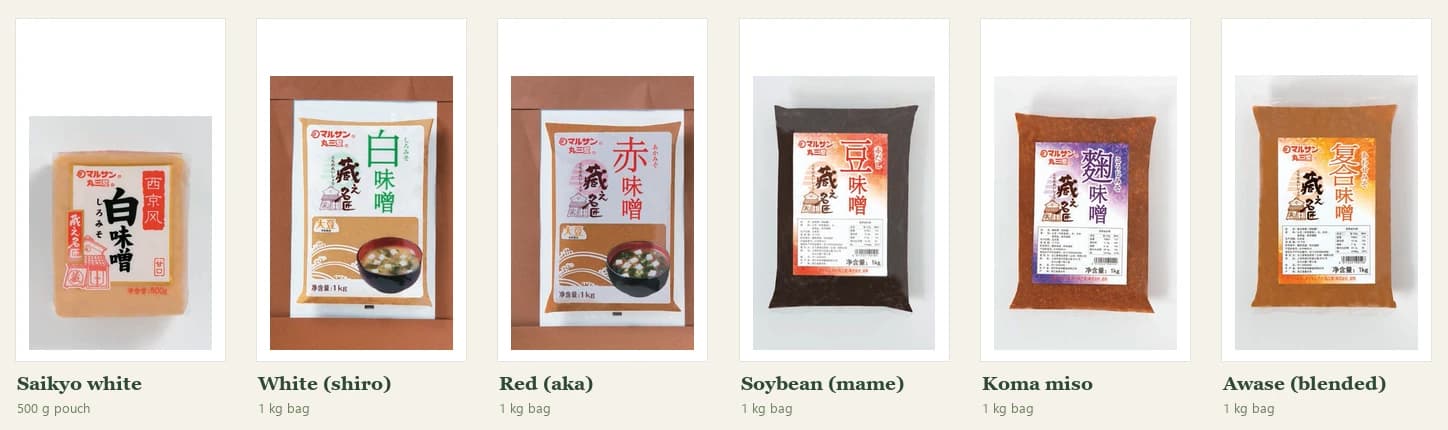
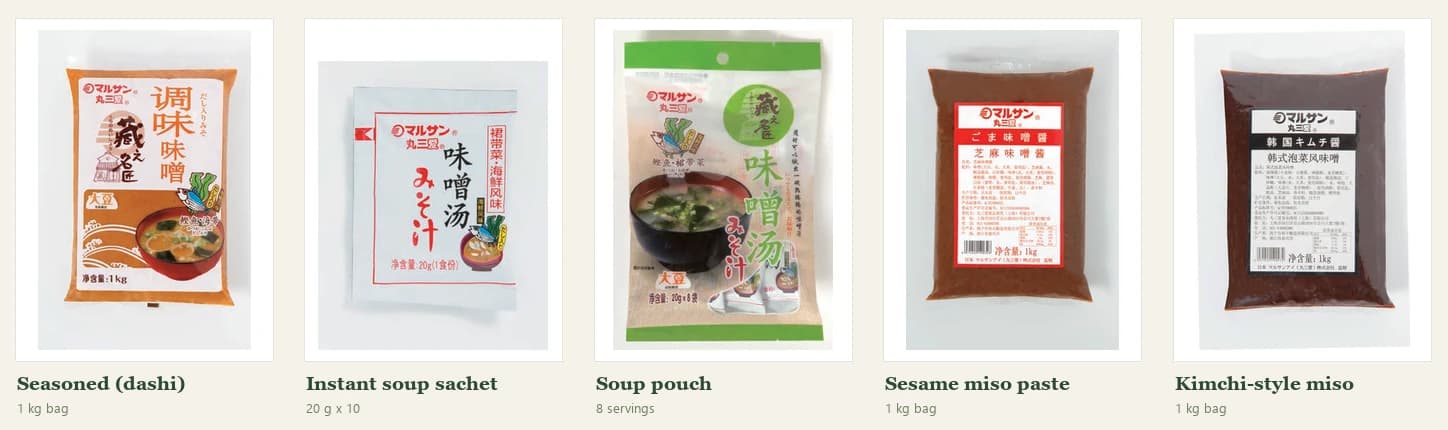
The Marusan Ai range in 2026 is wider than plain paste. It runs seasoned pastes, pickling grades, koji products and a drink, and each of those opens a different buyer conversation.
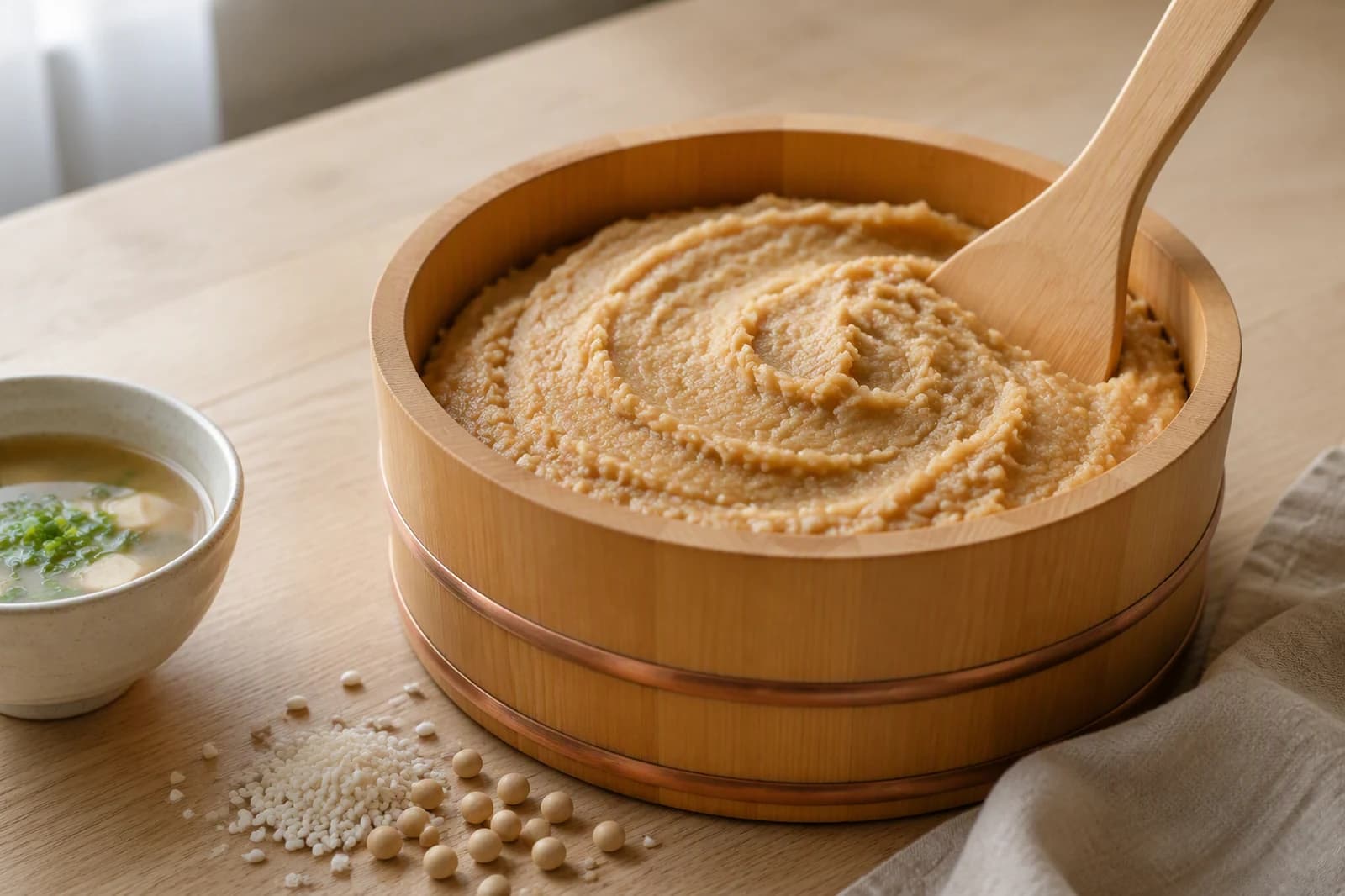
- Plain paste, bagged - rice-koji white, rice-koji red, Saikyo-style white, soybean-only, blended awase and a barley-koji type, all in 500 g retail bags.
- Boxed paste, 300 g - the smaller tub-in-box format for deli, gift and sampler shelves.
- Seasoned paste - bonito, kelp or mackerel extract blended in, so the paste makes soup with hot water alone. Sold in 1 kg bags for kitchens.
- Pickling miso - a separate grade in minced and whole-bean versions, formulated for curing fish, meat and vegetables rather than for soup. This is the line that serves misozuke and kasuzuke producers.
- Dispenser paste - a dedicated seasoned paste packed for soup machines, so a canteen or chain can serve a consistent bowl without a kitchen.
- Soup sachets - a 20 g instant sachet for one bowl and a 1.5 g powdered strip for trays and vending.
- Hotpot pastes - sesame miso and Korean-style kimchi miso, sold as a base in 500 g and 1 kg bags.
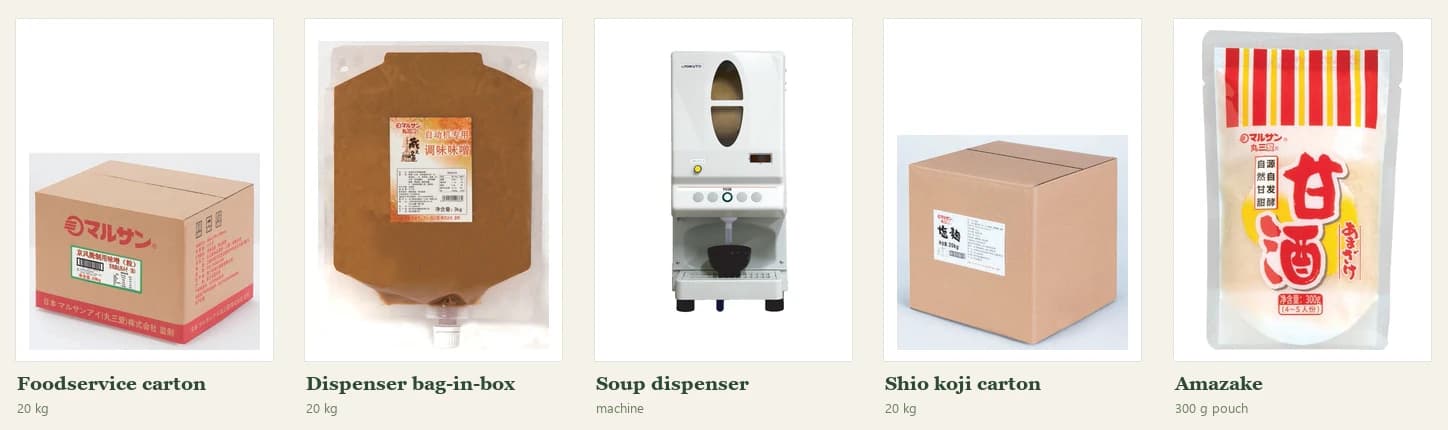
- Koji products - shio koji and soy koji, the enzyme marinades, in 500 g retail and 20 kg bulk.
- Amazake - a sweet rice drink, 300 g pouch, diluted with water before serving.
What goes into the paste, and the alcohol-free option
A miso formula is short. Across this range the base is soybean - non-GMO on every paste SKU - with rice, or barley on some lines, and salt. On the plain pastes that is the entire ingredient list, which is worth noting in a category where buyers expect to negotiate around additives.
Two variations sit on top of that base. Dashi-seasoned pastes add fish extract - bonito, kelp or mackerel - plus seasoning, which is why they carry a different allergen and nutrition declaration from the plain types. Pickling grades add sugar and seasoning, because they are built to cure fish, meat and vegetables rather than to be drunk as soup.
Many rice-koji pastes also list edible alcohol. It is added as a preservation step at packing, not as part of the flavour architecture: the koji ratio, the salt level and the aging schedule are what make the paste taste the way it does. That distinction is what makes the alcohol-free version possible - the same base, the same koji ratio, the same aging, run without the alcohol addition.
The line can be produced alcohol-free on request. Treat that as a formula requirement rather than a label change: raise it at enquiry, get it written into the specification, and confirm the shelf-life declaration for the alcohol-free version separately, since the preservation assumption has moved. Buyers in the UK and parts of northern Europe ask for it most often, and it is best settled before artwork rather than after.
Four numbers in the formula are worth fixing in writing whatever the alcohol position: the rice-to-soybean ratio, the salt percentage, the aging period in months, and the particle size - minced or whole-bean. Ask for them per SKU. Two suppliers quoting the same style name can sit far apart on all four, and the difference shows up in the bowl, not on the invoice.
The format ladder, with the carton data
These are the pack formats and outer carton dimensions in the current 蔵の匠 range. They matter because the same paste at the same tonnage price lands at a different cost per serving depending on which rung of this ladder you buy.
- Retail bag, 500 g x 20 per carton, 365 x 295 x 195 mm - the standard grocery pack across six paste types.
- Retail box, 300 g x 10 per carton, 365 x 295 x 195 mm.
- Seasoned bag, 1 kg x 10 per carton, 365 x 295 x 195 mm.
- Foodservice paste, 20 kg per carton, 348 x 278 x 248 mm - the workhorse for factories, central kitchens and repackers.
- Dispenser bag-in-box, 20 kg per carton, 385 x 305 x 220 mm - the format that connects to a soup machine.
- Soup sachets, 20 g x 10 per carton, 248 x 78 x 242 mm - one sachet to 160 ml of hot water.
- Soup sachet strips, 1.5 g x 50 per carton, 290 x 130 x 190 mm.
- Hotpot paste, 500 g x 10 (345 x 290 x 195 mm) and 1 kg x 10 (385 x 290 x 182 mm).
- Shio koji and soy koji, 500 g x 20 (365 x 295 x 195 mm), with a 20 kg bulk pack alongside.
Cost per bowl beats cost per kilo
Soup is where miso budgets are actually spent, so the number to compare is the bowl, not the carton. In the dispenser format the reference settings are 15 to 20 g of paste to 140 to 160 ml of hot water. On that basis 3 kg of paste yields 150 bowls at the 20 g setting and 200 bowls at 15 g, and a 20 kg carton works out at roughly 1,000 to 1,330 bowls at the same two settings.
That arithmetic is why a foodservice customer can pay more per kilo and still spend less per bowl. A paste dosed at 15 g in a dispenser beats a cheaper paste that a kitchen spoons out at 25 g, because labour and waste sit inside the second number and not the first. It also explains the appeal of the sachet: 20 g to 160 ml fixes the portion at the factory, so a hotel breakfast or a canteen line cannot drift.
Shelf life has to be part of the same sum. Paste products in this range are declared at 12 months, the dry 20 g soup sachet at three years and the 1.5 g powdered strip at one year. Ambient paste and chilled paste are different inventory decisions in a reefer, and the storage condition belongs on the specification sheet, not in an email.
For buyers building a range rather than a single line, the format ladder also sets the minimum order structure. Minimums in this category are usually quoted per design and per pack format, so three paste types in two bag sizes is a different negotiation from one SKU filling a container - worth deciding before the first enquiry, not after.
What to send with a first enquiry
Miso is a specification-led purchase. An enquiry that arrives as a product name gets a catalogue back; an enquiry that arrives as a brief gets a price.
Send the paste type (or the 蔵の匠 item name) and the intended use, the pack format and carton count, the quantity for a first order and for a year, the destination port and Incoterm, whether the label is yours or the factory's, whether you need the formula to be alcohol-free, and which allergen and nutrition format your market requires. Add a target landed cost if you have one - it tells the supplier which rung of the ladder to quote instead of guessing.
If you are working through the range for the first time, ask for two paste types in the same pack format. It isolates flavour from packaging, gives you a clean sample comparison, and usually settles the salt-level question before any label or tooling work starts.
Need a product-specific quotation?
Send Longki Foods your target product, pack, quantity and destination market. We will identify the information that still needs confirmation.
Request a Quote